 It’s said that aromas can remain with us and trigger memories for a lifetime. I know this is true. I clearly remember the clean, sweet herb scent of lavender sachets wafting up whenever my beautiful, gentle mother slid open the drawers or her highboy dresser or dabbed Yardley English Lavender cologne behind her ears. And though she died far too young (and deeply mourned) more than forty years ago, just a whiff of lavender in my garden or kitchen today instantly calls her up—still vibrant and in good health—in my mind’s eye.
With such an intensely pleasant association, I would have to love lavender. (See another post and recipe here.) But it’s only in the last several decades that I’ve enjoyed it in more than sachets, soaps, and perfumes. Since my mother didn’t grow any herbs in her garden, I started out knowing almost nothing other than that the dried herb was aromatic and that the distinctive purple flowers pictured in the romantic, Victorian-style images on her lavender bath products were charming.
 A whole succession of English regents used lavender. Queen Elizabeth I reportedly had a sweet tooth and always had a lavender conserve at hand to enjoy. Later, Queen Victoria used it lavishly and was largely responsible for its enormous popularity in the 19th century, as this quote from an 1895 book, Fragrant Flowers, suggests: “The royal residences are strongly impregnated with the refreshing odour of this old-fashioned flower, and there is no perfume that the Queen likes better than Lavender-water, which, together with the oil for disinfecting purposes, Her Majesty has direct from a lady who distills it herself.”
 The association of lavender with antimacassar lace and staid Victorian ladies, plus the arrival of more and more seemingly magical chemical air fresheners, deodorants, and disinfectants after 1900 doubtless account for it gradually falling out of favor in the second half of the 20th century. Up until the last twenty years or so, at least in the mid-Atlantic region, only a few herbalists and specialty growers were carrying lavender, and even fewer sold fresh blooms or live plants. Dried lavender was marketed almost exclusively for soap and candle crafting and very rarely suggested as an ingredient in cooking.
Now, thank goodness, this glorious herb is making a comeback, having captured the fancy of 21st century aromatherapy and culinary fans, as well as those suspicious of chemical additives and turning to natural enhancers again. I started growing lavender in the early 1990s, at first strictly as a garden ornamental. The curved spires are graceful and eye-catching and attract butterflies, plus I revel in the refreshing spicy-citrus aroma whenever I walk past.
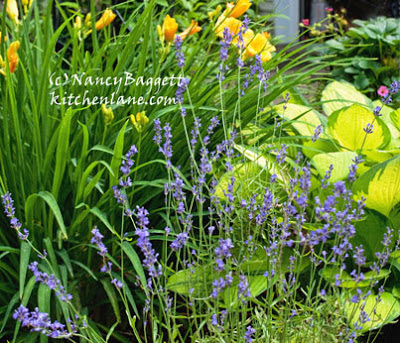
Truthfully, here in my Maryland yard cultivation is a bit of a challenge: The soil is heavy and mostly clay, and lavenders like it light and sandy. Much of my yard is shady, and lavenders prefer full sun. Many of the English lavenders whither from our intense summer heat, and the French lavenders are often killed by our occasional hard winter freezes.
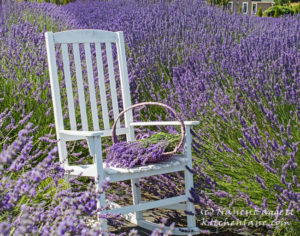
Some of my West Coast foodie friends report that lavender grows like a weed for them; dare I say I’m green–make that purple!–with envy! (The shot with the rocking chair was take at Creekside Lavneder Farm in Sequim, Washington, where the lavender is spectacular.) But so far the only variety I’ve found that thrives here in summer and survives the winter left in the ground (usually, if well mulched) is a hybrid variety developed specifically for my region called Phenomenal. But, I’ve had better luck growing the so-called English lavenders on my son’s property–the soil is sandier, has better drainage and the plants get sun all day long.
About ten years ago, I began experimenting with lavender in the kitchen and only wish I’d done so sooner. It adds a haunting, almost addictive dimension to baked goods such as shortbreads and to certain fruit and berry recipes, especially ones featuring blackberries, peaches or lemons. Try tossing in a couple lavender heads to infuse poached berries, or a sorbet mixture, or jelly or jam; fish them out when the cooking is done. Lavender is also excellent in pork dishes, and some beef and chicken recipes as well. Add some finely crushed dried buds to a honey sweet and sour sauce or glaze.
 Note that the buds, or bracts, and tiny blooms, or corollas, they hold, not the leaves, are the edible parts of this herb. Also, be sure to purchase “culinary” dried lavender for cooking purposes. Lavender for craft projects is not processed under the same standards and may not have an appealing flavor profile either. And you may be surprised to learn that certain kinds of lavenders, particularly the true, or so-called English lavenders, are much sweeter and fruitier tasting than most of the lavandin, or hybrid French lavenders.
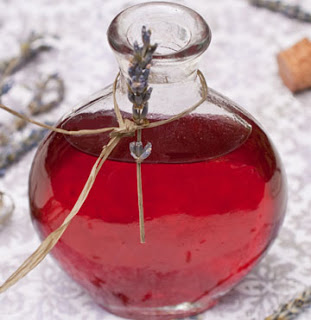
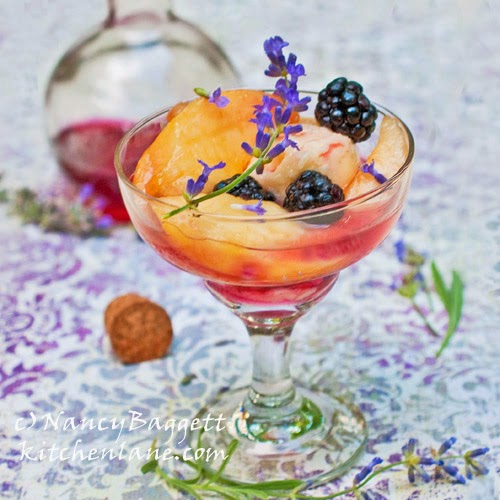
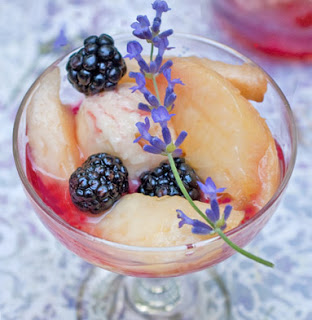
I don’t claim that this syrup has any medicinal properties whatsoever, it just tastes uniquely herbal-floral and pleasing. Splash or drizzle this syrup over mixed fruit compotes, or dishes of berries, melon, peaches or sliced nectarines. Add a little scoop of ice cream or sorbet and perhaps a pedestal serving dish, for light and simple, yet elegant sundaes like the one shown here. And do experiment with stirring a little syrup into hard or soft beverages; it is particularly winning paired with lemon drinks of all sorts and sparkling wine.
Depending on the variety, brand, and degree of freshness, dried lavender can be fairly mild or boldly flavored to the point of being overpowering. Take a sniff and then add in between 1 and 1½ tablespoons, as seems appropriate. Note that the blackberries are mostly incorporated for color. If desired, you can leave them out, in which case the syrup will have very pale grayish-lavender color instead.
- ¾ cup granulated sugar
- ¾ cup water
- 2 tablespoons clover honey, optional
- 4 to 6 fresh blackberries or raspberries washed, drained, and mashed with a fork
- 1 to 1½ tablespoons dried lavender blooms
- Stir together the sugar, water, honey, lavender, and blackberries in a 1-quart saucepan over medium heat. Bring to a boil, stirring, then adjust the heat so the mixture boils gently. Cook, without stirring for 6 to 7 minutes until the berries soften and break apart. Remove from the heat. Stir in the lavender. Let stand so the lavender can more fully infuse the syrup 30 minutes or up to an hour for a bolder taste.
- Push the syrup through a fine sieve into a saucepan. Bring back to a boil for 1 minute. Pour into a sterilized bottle or jar. Let cool to room temperature and store, refrigerated, for up to 2 weeks. Makes about ⅔ cup syrup. The recipe can be doubled if desired.
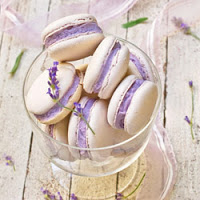
For a lavender buttercream recipe for cookies and French macarons go here.
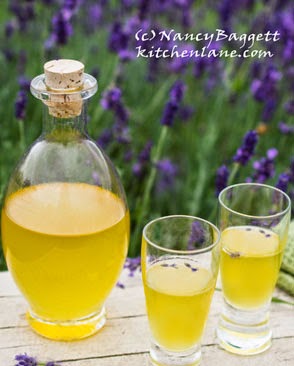
Or, to make a lavender-infused limoncello liqueur, go here.








Enjoyed reading this post..I want to start submitting and wanted myself to get ready for the criticism 🙂
Deb and Helen, yes, somehow lavender turns out to be addictive. Now I don't know how I got along without it in my cooking and baking.
I was also wary of a lavender flavor (I always loved the scent) until I tried a lavender macaron in Paris at Laduree, and there is no turning back now! This syrup sounds delightful!
I've only recently begun cooking with lavender in sweet desserts. It brings a lush aromatic flavor to baked goods and pairs well with citrus. I will be trying your tempting bread recipe as soon as I source more lemons. A scrumptious post!
There's lavender in my herb garden and I wasn't sure how to use it beyond decoratively. But a lavender spritzer–syrup and soda water–sounds like a refreshing drink for these hot days. Going to try it. Thanks for all the good suggestions, Nancy.
Nice to get your report from south-east Britain–thanks. Yes, I've heard it makes a nice jelly or jam, but I haven't tried it either. The cupcakes sound fabulous! I use fresh lavender in frosting for cupcakes, which also tastes wonderful.
Lavender grows really well in the South East of Britain. I use fresh lavender to make cupcakes. It's wonderful to eat. You can also make Lavender Jam/Jelly (I have yet to try this. Pick the lavender when the flowers are about a third open to get the best flavour.
I'm trying to grow lavender, too. One inside, one outside. They smell so good! So I love your ideas in this article!
I know they grow lavender north of here in TX. I may have to give some a try!
What a great way of putting it–"a touch of perfume on the tongue!" I love it! The buttercream is really delightful as a filling, and the syrup really is nice over fruit and/or ice cream.
Those lavender cookies look delightful! I too, associated lavender mostly with the scent, but about two years ago, my daughter made cookies using our homegrown lavender. It's such a delicate taste and not heavy at all, almost like a touch of perfume on the tongue.
I didn't know that the leaves were not edible. Thanks for the information. Fingers crossed that the lavender plant I bought this season makes it through the winter.
I didn't know that the leaves were not edible. Thanks for the information. Fingers crossed that the lavender plant I bought this season makes it through the winter.
This is perfect! I'm so into Victorian things these days–clothes, history, fiction, foods. Lavender is one of the scents and flavors that was as popular in the 19th century as it is today. Thanks for the great recipes, too!