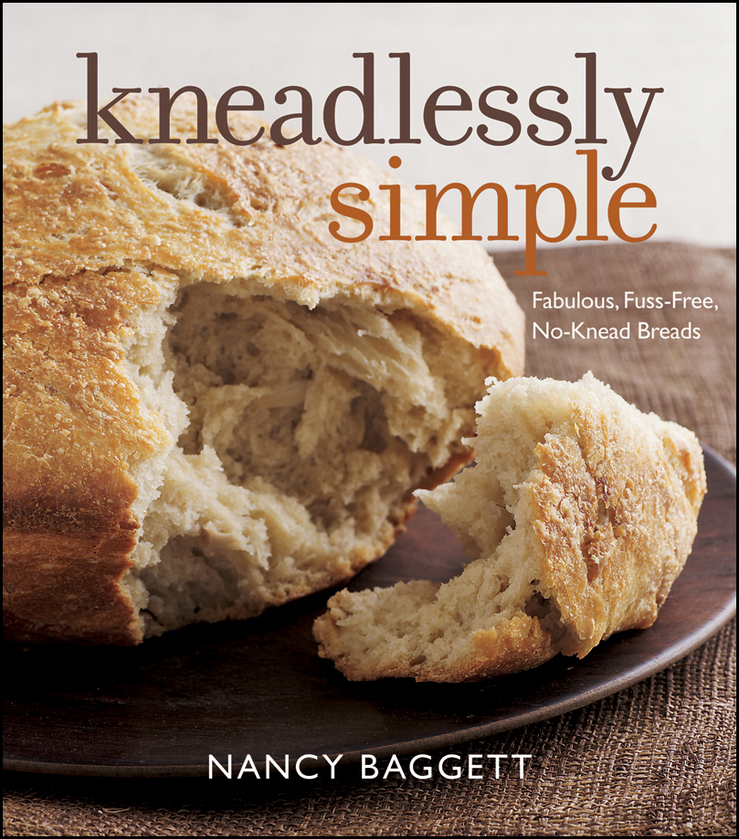
If you’re looking for a great holiday gift for a “no-knead” bread baking fan or for somebody who would like to make yeast bread but is a little intimidated, I have a suggestion. Give them a good bread baking pot, and, perhaps a copy of my popular Kneadlessly Simple bread book. Now in paperback, the book is very affordable, and so are a number of suitable pots on the market. Just remember that for nicely shaped boules, the pot should be around 8 1/2- to 9-inches in diameter and hold 3 to 3 1/2 quarts. In larger pots, the bread will spread out too much and yield an overly flat loaf.
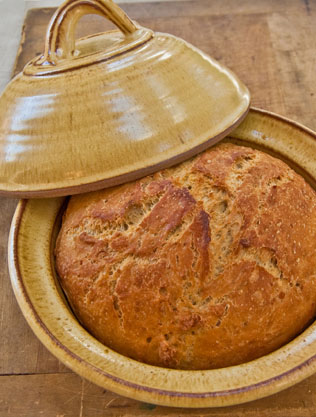
I tested a lot of Dutch ovens and pots in the process of writing my Kneadlessly Simple cookbook: Cast iron, enamel-coated cast iron, enamel-coated carbon steel, anodized aluminum, stainless steel, and several oven-proof ceramic casseroles just to name some. (Only certain ceramic casseroles are safe for baking; see details on stoneware containers like the handsome one shown.) They all worked, even a light-weight very inexpensive ($20) stainless steel stewpot that I’d initially thought might be too flimsy.
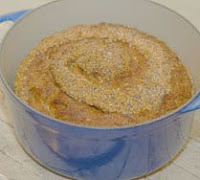
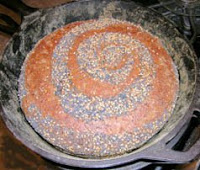
So when people started asking which ones worked best it was easy to come up with advice. Here’s the same bread, my Crusty Cracked Wheat, baked in a plain cast iron pot (below) and in a blue enamel-coated cast iron Dutch oven (above) with a light interior. As is usually (but not always!) the case, the darker pot interior surface delivered deeper browning. My white very popular peasant-style no-knead pot bread is here. A pale ale crusty bread is here.
Tip: Even though dough doesn’t usually stick to pots, it can, and I’ve never found a way to predict which pots will have sticking problems in advance. If you’re not sure, head off trouble by simply spritzing the pot with non-stick spray just before you put in the dough. (If you grease the pot before you preheat it, it will smoke.)
 >Looks Don’t Matter–The very pretty but pricey French pots are not the only ones that will work for crusty artisan-style loaves: Seasoned plain cast iron pots, which are much cheaper, are just fine. And some plain cast iron pots come already seasoned and ready to use. Enamel-coated carbon steel and anodized aluminum pots will also do a good job–and they are a lighter, so are easier to lug around. Enameled carbon steel pots tend to have hot spots, so I always bake at a slightly lower temp with them.
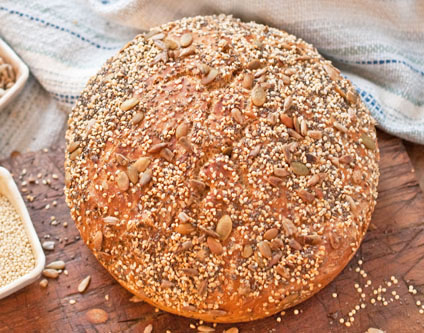
> Bigger Is Not Necessarily Better–Many pot bread recipes circulating around today call for pots that are larger than is optimum. Loaves calling for 1- to 1 1/4-pounds (3 to 4 cups) of flour will dome more and look better if baked in a 3 1/2 to 4 quart pot. (A 3-quart pot with a domed lid will work, too, as the dough can expand up into the top.) The 6-quart pot I’ve often seen called for results in loaves that flatten out too much, although, of course, they taste fine. (The recipe for the handsome “kneadless” Seeds-a-Plenty Wheat Boule shown below right is here.)
>Hot Enough for You?–Some pot bread recipes call for preheating the pot at high heat (450-500 degrees F), so be sure the knob or handle of the pot you choose is heat-tolerant. I’ve bought several great pots only to discover the knob or handle could only be heated to 400 F or so degrees. In one case, I just unscrewed the phenolic knob and replaced it with a brass one purchased at the hardware store. The preheating step means that pots made of glass and ceramic can be a risky proposition: They may crack or shatter when the cooler dough is dumped in. Skip them unless the manufacturer specifically says it’s safe go directly from freezer to oven.
You’ll find more helpful info on selecting bread pots here. For more bread pics and hotlinks to more free bread recipes, click here. The recipe for the crusty wheat bread at the bottom left is here.









Hi, Edelwiess. Yes, if you live in a tropical climate I'm sure the proofing times could be shortened. The problem with yeast breads is that the yeast are living and respond to the climate moisture and temperature. Just as I'd expect plants to grow differently, it sounds as if the yeast organisms are responding differently. I'd say as soon as you see the dough getting really puffy and bubbly on top, you should proceed with the next step. Hope this is helpful.
Hi Nancy,
I tried baking a few recipes from your book and they've not all been successful (but I won't stop trying!)
My question is about proofing times. I know the long hours contributes to the micro-kneading; however I stay in a tropical country (30C plus) and I'm wondering if the proofing needs to be shortened, and if so, by how much? So far I've proofed my breads for about 12hrs 1st rise and 1hr 2nd rise and some were too dense and others were okay so I'm hoping for some advice here. Thank you!
I don't know what the problem might be with the Ikea pot. But I'm betting that spritzing the pot with oil spray right before you put the dough in it would help. I also don't know why the breads wouldn't be successful–that said, with my particular recipes you must use Instant or Fast-Rising dry yeast–yeast cakes or regular dry yeast will not work.
Hi. I wonder if I should change the Ikea pot which I bought for a new one. It's frustrating bcs each time the loaf sticks. I do not know what the problem is as I seasoned it as instructed and oil it after each washing (just a gentle rub with a piece of cloth). I was very gentle with it.
I baked apple pancake twice and both times the egg got stuck to the bottom and the sides of the pot. I'm at wit's end trying to figure out what I had done wrong. Anyone has any idea? Thanks.
By the way I'm sticking to the kneading method as my no-knead bread-making attempts are all disasters!
Hi again Nancy,
I could not find my posts bcs I forgot the page title. Finally i googled and google was spot-on!
Yesterday I bought the 3qt round Ikea Senior cast iron casserole pot and will bake my first loaf later this evening. I'll update you on the results. So far I've been baking rather good loaves using the traditional kneading method.
Thanks Nancy. No,I'm not in the least daunted. Yesterday I tried baking a rustic loaf using the kneading method. Kneading is really so easy and an enjoyable tactile activity. The result was very good. It was flavourful and the texture was just right,no big holes,no stickiness. It was crusty too.
I just baked it in my pizza tray,using the basic made-in-China oven. Might stick to this method if the no-knead method doesn't work for me but I'll try as soon as I buy a dutch oven. However,with the dutch oven I would need a new oven as the temperature reader of my present oven doesn't work anymore. If I bake without the pot's lid on I can always watch the loaf through the oven's glass cover.
The human being is highly resourceful. We will go back to science when we don't have technology. My basic oven is such simple technology yet it does the work rather well. The loaf browned evenly.
I'm not surprised the bread stuck to the Pyrex. Somewhere in the book I mentioned that it's a good idea to spritz pots you aren't sure of with a little nonstick spray just before they go in the oven. This definitely needs to be done with the glass-ceramic pots like Pyrex. I'm not surprised the stovetop cooking didn't work either–with all the heat coming from the bottom, it is going to burn! Glad the little setbacks don't discourage you. Happy baking!
Thanks Nancy. I did try baking with my Pyrex fish dish yesterday but the bread stuck. The dough rose very nicely after I added a wee bit more yeast. I think I'll have to get a cast iron pot or a heavy stainless steel one. Our water is not hard so there should be no problem with it.
Unfortunately,my basic made-in- China portable oven's temperature reader does not work (must get a proper oven)so I have to check on whatever is baking and if I forget things get burnt.
Yesterday I also tried baking directly on the gas stove using an old about-to-crack cheap Indian claypot LOL (made locally here,not in India). The bread looked like steamed bread but the bottom was burnt charcoal black and the bottom of the claypot just cracked up. I managed to salvage the upper half of the bread. It was time to throw away the pot though it was a nice pot to use.
Well,these trials and tribulations are interesting but frustrating as well. I learned a thing or two from my experiments. Thank you so much for this exchange of ideas. I learn too from reading your answers to the questions of other readers.
I don't think the bread can be baked on top of the stove. You need an oven, though either electric or gas would work. I am surprised that your bread isn't rising more; the warm temperatures usually encourage rising. Perhaps you could try using a little more yeast than is called for; or if your doughs are on the dry side, you'll probably get more rising if you make them a little softer. Another possibility–try bottled water–this would eliminate the possibility that there is something in the water that is inhibiting the yeast.
Thank you for your kind reply. I might buy the 3qt round Senior Ikea cast iron pot. I guess I could bake the bread in a pyrex casserole but mine is for fish and I much prefer a round pot.
I truly wonder if it is at all possible to bake the bread on a gas stove?
I have another problem. My bread does not rise much so I end up with a very dense loaf. Is it because the weather here is so hot,ranging from 30-32C?
Thanks for writing. I think that if the lid is domed, you might actually find that the 3-quart pot is large enough. The cast-iron one you describe sounds fine. Yes, you could cut down the proportions of the recipe, but it might be easier to just cut off part of the dough and bake it in a smaller, separate container–say maybe a small oven-proof casserole with a lid (or a make-shift lid made of aluminum foil. It would of course bake in a much shorter time–so you could be sampling sooner!! Good luck!
Hi Nancy, I'm writing from South East Asia. I've always loved crusty European peasant bread. It costs so much at upmarket bakeries.
There's only one Ikea outlet near where I live and they have only a 3qt cast iron pot (matt-finished on the inside and enamelled on the outside). Do you think I could use 3 cups of flour? Would the dough be too big for the pot? Also I do not own a real proper electric oven. Is it okay for me to put the pot on my gas stove?
Thank you. The very idea of baking my first crusty loaf is so exciting!
I already owned a 6-qt. Lodge Color Dutch oven (& replaced the plastic lid knob with a metal one from the hardware store), but also got a 3-qt. Dutch oven (Tim Love Collection; comes with metal knob already) for Christmas — so I'm all set. I intend to order a copy of your book later today (probably from Barnes & Noble), and may bake my first no-knead bread this week (we'll probably have a "snow day" later this week in central IL due to heavy snow, so I'll have the time).
I have made the Crusty Peasant Bread several times and it is FANTASTIC! Thank you, Nancy!! My family thinks it rivals the best bakeries in town (and we have great bakeries in Portland, OR). Perfect results and almost no work! I've used an All-Clad saucepan, Lodge Pre-Seasoned Cast Iron Dutch oven and Le Creuset 3-1/2 quart Dutch oven. All were good, but the Le Creuset gives the best results and is the perfect size (the Lodge was cheaper but too large so the bread was flatter, but you could probably increase the recipe). I solved the knob problem by wrapping it in several layers of aluminum foil (which I keep and re-use). I make this bread every week (two recipes are in progress right now!), so the Le Creuset was a good investment for me.
You can definitely bake in a loaf pan instead. Just be sure to use a 9- by 5-inch pan–anything smaller won't hold all the dough. Also, you will have to adjust the baking proceedure a bit. A dough baked in a pot donesn't brown as fast, so you may have to cover ones baked in a loaf pan with foil part way through to keep them from over-browning.
I don't have a suitable pot for making the pot breads in your book… if I tried making them in just a regular loaf pan would they still be ok (just not as crusty, which is fine with me), do you think?
Yes, a stainless knob would work fine. Actually it might be better, since stainless does not conduct heat as well and the knob wouldn't get as hot!
You said you replaced the knob with a brass one, could you also use stainless? Thank you for the information.
Yes, it’s likely that your pot is a little thin, or your oven runs a little hot (or both). I would just reduce the heat by 25 degrees F. If your breads still seem too brown on the bottom, you can also try baking on the middle rack. That should solve the problem. Hope the bread tasted good! BTW, the preheating not only encourages the steam that develops the crustiness, but also sears the outside of the dough so it is less likely to stick to the pot.
I just baked my first loaf…wow, it looks great on top! The sides and the bottom look a little too dark; either the pot I used was too thin (?) or my oven is running too hot (I have a gas range). Should I lower the heat? If so, to what? The bread I made called for the pre-heat of oven and pot at 450 20 mins. prior to baking and then lower to 425. Can’t wait to taste my first effort.
Thank you for your answer! I will forget the fresh yeast and try the dry one. I´ll let you know how the result was!
Thanks for writing. I am not sure how Finnish yeast would work since I haven’t tested it, but I think your suggestion of waking the yeast by combining it with a little flour and 42 C (slightly warm) water is probably the best course. Then, if it is not “instant” yeast that dissolves readily in cold water, it will still be fine. After the yeast wakes up a little, I would then just add the warm water-flour-yeast mixture to the rest of the dry ingredients, and add the cold water as directed. I would not use fresh yeast in the recipe–the quantities would be very different and the recipes would probably not work well. Good luck.
By the way, I would love to hear how your approach works out. If you have time, please let me know.
Hello from Finland! Just received your book and it seems great, thank you!! Luckily also found your website. I have one question… In Finland we have dry yeast that requires water of 42C/108F in order to wake up. The yeast is mixed to flour and then you add the water. How would this yeast work with your method? Should I wake up the yeast first in small amount of flour and hotter water and then proceed according to your instructions – or? We have only this one kind of dry yeast and then fresh yeast which is dilluted to luke warm water 37C/99F. If I used fresh yeast what would be the right amount in your method?
Appreciate your kind answer,
Best Regards
Tina
Thanks, Nancy
I’ll give it a try (or quite a few tries) and let you know how it works out.
From the photos on-line, it looks like the la Cloche bakers are thin-walled poured pottery, probably of low-fired clay, which I would expect to be fragile. My instinct would be to make a piece for this use with thicker walls, but then of course, it’s heavier to ship, which is a big deal these days.
Anyway, thanks for your reply. I much appreciate it, and I’m really looking forward to reading and trying out your bread book.
I haven’t tried using clay pots–I don’t know that I’d be able to tell how they were fired. I have been reading that the la Cloche clay bakers tend to be fragile and crack from heat, but I have no idea how they are fired. As long as they stay in one piece, they apparently do yield a very crusty bread.
I just ordered your bread book, and maybe something there will answer my question, but I’m curious. Have you tried bisque-fired or low-fired clay pots (more heat-shock tolerant)? As I’m a potter, I’ll probably experiment with this, but am curious as to whether you already know?
Thanks, Cindy
good advice!