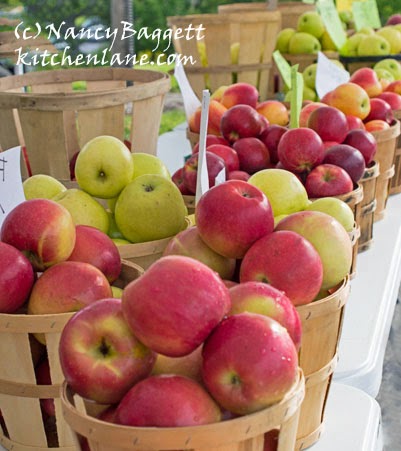
When you’re out at the farmers’ market or in the supermarket, does it make a difference which kind of apples you buy for preparing whole baked apples? Are some apples–like some potatoes–better suited for baking whole than others?
The answer is yes! After conducting informal comparison bake-offs of different varieties over several autumns, I’ve determined that some apples make beautiful and delicious whole baked apples and others don’t. One result may totally surprise you–the Granny Smith doesn’t look or taste good baked whole. (Check out the pic below for the proof!) If you are looking for a super good and easy recipe for whole baked apples go here.
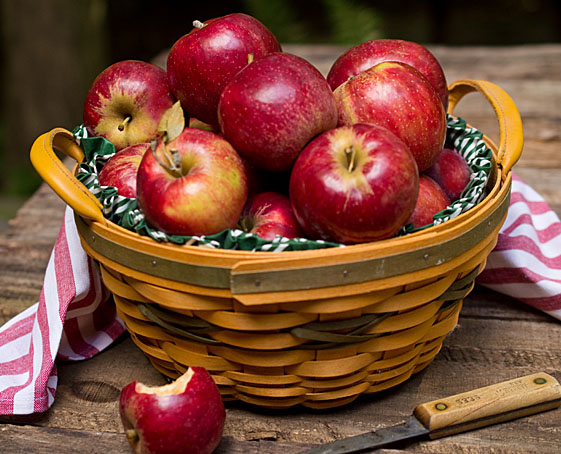
Jonathan apples
The basket above contains one of my favorite old-fashioned baking apples, the Jonathan. When you can find them, they are delish right off the tree, or cooked or baked. Their only drawback is that they are somewhat hard to find, and they tend to be smallish so when baked whole the finished servings are on the modest side.
As I learned from extensive comparison testing, some baked apples come from the oven temptingly colored, nicely shaped, and with full-bodied fruit flavor and aroma. Others emerge looking a bit slumped and faded, but tasting appetizing. Still other kinds emerge bland, limp, or mushy, or all three. Though you might (rightly) guess that very crisp, tangy, intensely flavored apples are the best candidates for making whole baked apples, not all the varieties in this category actually do perform well. The Granny Smith, as you’ll discover below, was a dud!
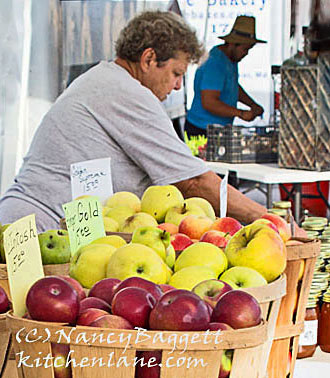
It’s common for recipes simply to call for “baking apples,” or “tart apples,”or “large apples,” which is not really helpful! Occasionally they specify Granny Smith or Golden Delicious or Rome; a few suggest McIntosh. So I tried all four–and not all made good baked apples at all! (BTW, when you want “baked” apples in a hurry, try my handy –and yummy Microwave-Baked Apples.)
Here are the results of my comparison bake-off: The Rome apples held their shape, although the skins tended to split and lost a lot of the original pretty red color. The flesh tasted pleasantly tart.

The McIntosh apple, shown below, split apart and completely collapsed; they were not attractive baked apples at all! Their flesh softened to the point that an actual applesauce bubbled out the center tops. (No wonder they are often called applesauce apples.)
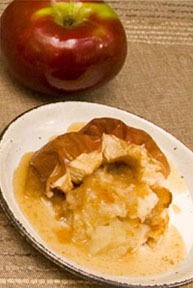
McIntosh turns to applesauce
The Golden Delicious were okay, but not at their best either. They kept some shape, but their handsome yellow skin faded a bit. They tasted good as baked apples, but I felt that baking muted the tantalizing fruity-sweet flavor that’s the best feature of these apples.
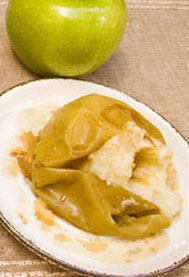 |
| Granny Smith baked apple |
The Granny Smith apples were a surprise–and not in a good way! Baking seemed to bring out their usual tartness (make that sourness), but not their flavor. Plus, they collapsed completely, and their skins turned a homely olive drab as you can see in the pic at right.
So, I set out to find varieties that would make better whole baked apples. Eventually, I tried over 30 different kinds (above are some of the choices shown being baked)–carefully labeling each type to keep the contestants straight. I baked them all in the same kind of dishes, with the same recipe, in the same oven. I always tested two of each type at once, to be sure the results were characteristic and not a fluke.
Every apple was sampled and informally rated by two or three tasters.The details are in, and there is not one all-out favorite, but several “best bakers” available this time of year. They are listed below, along with my comments and testing notes. Additionally, I’ve mentioned a number of other varieties that bake up nicely and are well worth trying—some of these may be hard to find.

Honeycrisp apples
In case you don’t see your favorite apple suggested, there are several possible reasons. In general, most of the popular eating apples–Red Delicious, Gala, and Fugi, for example–simply don’t stand up to the heat. A lot of their appeal comes from their mild taste, lack of acidity, and gratifying crispy texture. Baking tends to negate these qualities. Plus, not only the McIntosh but the Cortland and Macoun (both crosses of McIntosh with other apples) tended to break down when baked whole, although their flavor was pleasant. Of course, if you grew up enjoying these varieties, their applesaucy consistency may strike you as just the way baked apples should be!
A while back, I invited Guy Raz, host of NPR Weekend All Things Considered to come to my kitchen and do an apple comparison tasting. You can catch the short interview and find out what apples Guy liked best here.
Best Apples for Making Whole Baked Apples
Empire–This is a cheerful red, sweet-tart apple. It’s s a cross between McIntosh and Red Delicious and a far better baker than either of its parents. The skin turns an attractive, though unusual pinkish-red when baked, and the flesh usually holds together and wins points for its honest, gratifying fruit flavor. The apples range from medium-large to large.
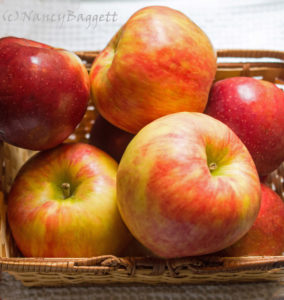 Honeycrisp –A 1960s Minnesota introduction that’s descended from Macoun, Golden Delicious, and Haralson apples, this large, super-crisp, and sweet yet tangy variety is shown in the basket at left. The Honeycrisp holds its shape fairly well when baked, and its reddish-yellow skin takes on an attractive tawny-gold hue. As the name suggests, the flesh also has a faintly golden color and a memorable sweet and mellow flavor. This is one of the best choices for make whole baked apples–it’s my fave.
Jonathan–This old favorite (shown in the top left of the basket with Honeycrisp at left) doesn’t hold its shape as well as some other varieties during baking, but its complex sweet-tart flavor comes through clearly, so it gets a top rating for taste. The reddish skin retains some color, another plus, though it is slightly tough. One drawback for those who prefer their baked apples large is that Jonathans are rarely more than medium-sized, 5 to 7 ounces each.
Rome–Also called Red Rome and Rome Beauty, this bright red apple is recommended primarily because it’s very large (sometimes huge!) and impressive looking, and its zesty-tart flesh maintains its integrity during baking. However, the skin does fade to russet-red and may split; sometimes it also becomes a little tough. The apple flavor is not complex, but quite zesty, which complements the classic brown sugar-cinnamon combo nicely.
Braeburn- A New Zealand apple from a chance seedling discovered in an orchard of the same name in 1952, the Braeburn is good for baking whole, as the pic at the bottom left indicates. It looks attractive, and also has a pleasant middle-of-the-road apple flavor, especially when very fresh. It is usually 7 to 9- ounces, which yields a medium-sized baked apple. These are featured in my 2-ingredient, 10-minute microwave baked apple recipe here.
exact parentage of Braeburn apples is unknown but they are believed to
be a relative of the Lady Hamilton and Granny Smith apple, both
varieties which were growing in the orchard where the Braeburn apple was
first discovered – See more at:
http://www.specialtyproduce.com/produce/Braeburn_Apples_673.php#sthash.prsTdJvI.dpuf
exact parentage of Braeburn apples is unknown but they are believed to
be a relative of the Lady Hamilton and Granny Smith apple, both
varieties which were growing in the orchard where the Braeburn apple was
first discovered – See more at:
http://www.specialtyproduce.com/produce/Braeburn_Apples_673.php#sthash.prsTdJvI.dpuf

Honorable mentions: Cameo, Crispin, Gravenstein, Jonagold, Nittany, Pacific Rose, Paula Red, Green Pippin, Sansa, Stayman, and Summerfield.








By the way, I do try to work hard to be sure that peeps can have success with my recipes, so it is super nice that this is appreciated. I also find that if readers know the reasons behind certain instructions they are more likely to follow them!
Thanks for your compliments! Yes, I have written many cookbooks. If you go to Amazon and type in my name a lot of the books (some coauthored) will come up. I know that Jonathan apples are often small, or at most medium-sized, but I love them anyway!
I love your recipes and you have the most amazing way of explaining what you do and why; and that is crucial for someone like me who is certainly not a professional! There is nothing more frustrating than having to google a term in the middle of a recipe that is described as “easy”. My favorite thing about using your recipes is the fact that you read people’s comments, and even respond to a lot them, sometimes even years after you posted it! It tells me that the information is still relevant and that you care that people have a good experience using your posts I feel like your passion for making great food matches mine and I have not only learned so much from you, but also can’t wait to try the next thing you suggest (the baked apple crisp will be next) I appreciate that you explain what certain ingredients are, why you used them, and what the alternatives are (such as in your concorde grape sorbet recipe about the pectin). My question is: does anything change for high altitude? I’m at around 9,000 feet and although I know some tricks when it comes to pastries and cookies, I dont know how or if altitude effects baking fruit. What I do know is that my friend just bought a home down the mountain a little way that has a huge jonathan apple tree. Unfortunately the majority of the apples are only around 2 ounces each, but they taste delicious! So we’re having a baking party to see what people can do with these apples! I digress. Anyway, I just wanted to tell you that I appreciate your dedication. Your recipes are my first go-to now, whenever I need one. Do you have a book? If not, you should write one!!
Thanks for your insights/information. I love your mother’s suggestion except for Granny Smith for pies, which IMO have a one-dimensional flavor. A mix of three or four kinds is much better in a pie. Pick Lady is good for eating; I have never tried to cook with it.
As a native of upstate New York who worked in a farm stand for my first job, I consider myself an apple expert! I love my Mother’s choices (life long NY resident):
Rome apples for baked apples, Cortlands for applesauce, Winesap for eating, Granny Smith for pies. Unfortunately, after endlessly searching for Rome, Cortland, Winesap, Empire, Northern Spy etc in Colorado I learned they are “east coast apples.” Our stores order from the west coast. I have learned to use other apples for applesauce, and found Pink Ladys the best for eating. Came to this site in search of the best choice for baked apples. Thank you!
I have heard so much about Northern Spy, but don’t think I have ever tried them. I live in MD. I thought they were from NY, will have to check if my sister in PA can find me some next fall. I’d like to see what they are like!
Out here in Utah longing for the Northern Spy apples I had growing up in my native Pennsylvania .
I certainly agree that flavor is important, and I love to put the Macintosh and several others together in an apple pie. But when the apple has to be the star, I just think the mushy look of the Mac is unappealing. As a pro you know that looks have to count, too. Plus, you don't have to sacrifice one for the other–the Honey Crisp is not only attractive baked, but tastes really good.
As a professional pastry chef I think you must weight the flavor of the apple along with its structure. In my opinion, both red delicious and golden delicious are a great eating apple but I don't care for the flavors when baked.
I personally prefer using Granny Smith where I want it to stand up to the baking process however, you can't beat the flavor of a Macintosh or Pink Lady!!!
I like the Pink Lady for eating, too. I think I tried baking it a couple of years ago, but wasn't impressed. But I can't recall exactly why. If you have good luck, please follow up so I can add it to the suggested list.
Good Essay on the apple. I especially like the part where you mentioned a baked apple is only as good as it was when it went in. I will definitely try the Braeburn next time I bake. Any luck with the Pink Lady? My favorite eat'n apple, but I have never baked with it.